|
A Song of Repentance: the Great Canon of St Andrew of Crete adapted
from the website of pravoslavie.ru Editor's Note: This
is admittedly a long article. The Editor has marked off sections at natural breaks in the narrative so the reader, if
he or she chooses, may read the article over six days.
Introduction The experience of Lent is a spiritual journey whose purpose is to transfer us from one spiritual
state to another, a dynamic passage. For this reason the church commences Lent with the great penitential Canon of Saint
Andrew of Crete. This penitential lamentation conveys to us the scope and depth of sin, shaking the soul with despair,
repentance, and hope.
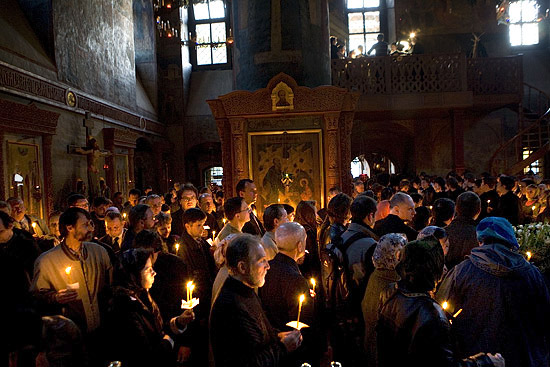
The only times it is appointed to be read in church
are the first four nights of Great Lent (Clean Monday through to Clean Thursday, and fourth sections of each ode are read
at Great Compline) and at Matins for Thursday of the fifth week of Great Lent, when it is read in its entirety (in this latter
service, the entire life of Saint Mary of Egypt is also read).
This complex poem (actually a chanted hymn) was written in the early 700's, and it picked up the adjective "great"
for two reasons: it is extra-long (about 250 verses), and it is majestic. It is a liturgical poem consisting of nine
odes. The Great Canon was written by Saint Andrew of Crete, a bishop who was initially a monk in Jerusalem.
The
whole Canon is a kind of "Walk Through the Bible." Saint Andrew begins with Adam and Eve and goes all the
way through, exhorting himself by applying stories and characters of the Bible. Reading the Canon helps us to see how
Christians in the Holy Land 1,300 years ago understood the Scriptures. It is a way to time-travel, and actually joins
them in these ancient Christian devotions which are part of the dynamic life of the Church.
Father Alexander Schmemann
says about the 'great canon of repentance' that: "....with a unique art, Saint Andrew interwove the great biblical
themes -- Adam and Eve, Paradise and the Fall, the Patriarchs, Noah and the Flood, David, the Promised Land, and ultimately
Christ and the Church -- with confession of sin and repentance. The events of sacred history are revealed as events
in my life, God's acts in the past as acts aimed at me and my salvation, the tragedy of sin and betrayal as my personal tragedy.
My life is shown to me as part of the great and all-embracing fight between God and the powers of darkness which rebel
against Him."
Of the Canon, Father Alexander continues: "The Canon begins on a deeply personal
note...One after another, my sins are revealed in their deep connection with the continuous drama of man's relation to God;
the story of man's fall is my story".
Father Alexander
goes on to say that these stories from Scripture are so much more than merely allegories. He reminds us that even though
we are each unique persons, we are all moving through the same drama. We all face choices that through the ages others
have faced before us and just as we must choose the sacred pathway to return to God so they had to choose; and in their choosing
have much to teach us, to remind us, to reveal to us the tried and tested path to life. And it is in this way that my
own and deeply personal sin becomes the lens through which I can begin to grasp the real importance of His redemptive acts.
Part
of the reason that we are so vividly lukewarm in the faith, according to Father Alexander, is that we are too much concerned
with the things of the world, and we fail to remember the true heights from which we fell from grace as sons and daughters
of Adam. This is something which is common to all mankind through the ages, but Father Alexander adds another element
to this that brings it closer to the reality of contemporary life. He says: "Sin....is thought of primarily as
a natural "weakness" due usually to a maladjustment, which has in turn social roots and, therefore, can be eliminated
by a better social and economic organization. For this reason, even when he confesses his sins, the modern man no longer
repents... [he] shares his problems with the confessor -- expecting from religion some therapeutic treatment which will make
him happy again and well-adjusted".
However, the Great Canon, says Father Alexander, reintroduces us to the truth
about sin and our sinfulness. It directs us back to the culture of Creation, Fall, and Redemption where we may have
some chance at once again to recall our experience and existential failures in our life. Therefore, repentance from
sin is: "....the shock of man who, seeing himself the "image of the ineffable glory," realizes that he
has defiled, betrayed and rejected it in his life; repentance as regret coming from the ultimate depth of man's consciousness;
as the desire to return; as surrender to God's love and mercy...[allows confession to become] meaningful only if sin
is understood and experienced in all of its depth and sadness", as the rejection of communion with God.
Unfortunately,
the culture in which we live excludes the concept of sin or distorts its notion in relation to the biblical and Christian
tradition. For if sin is, first of all, humanity's fall from an incredibly high altitude, the rejection by humanity
of its 'high calling', what can all this mean within a culture which ignores and denies that 'high altitude" and 'calling,'
and defines a human not from 'above' (according to the image and likeness of God) but from 'below' (according to mere biology
or physiology). Sadly, this culture we live in thinks of human life only in terms of material goods and thus ignores the fact
that human beings have a transcendental vocation.
The
biblical and Christian tradition of sin has a depth and density which the culture in which we live is simply unable to comprehend
and which makes confession of sins something very different from true Christian repentance. Fort this reason, the Great
Canon reminds and teaches us that the ground that we need to walk in order to return to anything resembling the "image
of the ineffable glory" is a field that we too often leave uncultivated and neglected. For most of us, locked into
the familiarity of institutionalized, rule-bound, and well-worn praxis, the simple words of the Canon, which have so much
to do with acts of self-denial and obedience, are a wilderness of exceptionally rich and unfamiliar ground in the culture
in which we live and which shapes our world view.
++++++++++++++++++++++++++++++++++++++++++++++++++ A Summary and Brief Overview of the Main Theme of Repentance
This poem, beloved by the Eastern Church, lets
us overhear a conversation between Christ and an old man who knows he will soon die and then face judgment on all the deeds
of his life.
It is a dialogue between Saint Andrew and his
soul. The ongoing theme is an urgent exhortation to change the direction of one's life. Saint Andrew always mentions
his own sinfulness placed in juxtaposition to God's mercy, and uses literally hundreds of references to good and bad examples
of the OT and NT to "convince himself" to repent.
Andrew
asks renewed forgiveness for his known sins and the light to uncover any hidden leanings still within him that, if uttered,
would show how unfit he was to talk openly with his Lord. Christ, in words found in Scripture, reminds Andrew of how
all-inclusive the two commandments of love are, and how eager he is to greet prodigals when they return.
To many, the mere thought of anyone having to face judgment will be terrifying.
Imagine: an all-knowing God coming to question us, weak with age, about things we did in youth, middle age, and later years!
When, however, we hear this poem chanted in church, it will strike us as indeed
grave, but still consoling because it shows Christ's never-failing desire for us to become one with Himself. He wants
to talk personally with us in the way God did with Adam in the coolness of the afternoon.
Andrew has a vivid sense of his own failings, but despite this, the conversation between him
and Christ is between people who love one another. Andrew is talking to his soon-to-arrive judge, but he knows Him to
be presently anxious to help him put on the wedding garment guests need to wear.
The old man grieves over his past wrongdoing, but expressions of this concern are interspersed with memories
of his master trying to find lost sheep or search for lost coins that have the king's image stamped on them. Even more
to the point, Christ condemns our failings because He wants us to be better and to live fully.
In listening to Andrew, Christ hears an old man who has spent his life seeking to find what
his Master wants. How, in these last days, that old man is striving to know whether there are unknown commands he has
not heeded, or failings he has neither recognized nor confessed. From the bottom of his heart he is begging his Lord
to help him become a good disciple; he fears being disowned by someone he loves and whom he knows wants him not to fail.
There is no better way for any of us to learn what God wants of us than meditating
on the stories of good and bad men spoken of in Scripture. Andrew has been pondering on them during all the years of
his monastic life. Now, in old age, he is going over in his mind texts grown dear to him and peering into them in hope
of discovering lessons he has missed.
He does not,
like some scholar, speak in an orderly way of all parts of Scripture simply because they are there to be read dispassionately.
Instead, Andrew will be listening for messages God set down for us to heed. In the light of those stories there
is one more chance to find out how he falls short of thinking and feeling as God does.
Memories of past blindness renew his worry about wrong desires that may still be lurking in
some corner of his heart. Therefore, he keeps asking for both forgiveness for the failings he knows about, and help
for him to uncover still hidden ugliness.
The Great Canon
shows us the thoughts of someone who reads the Scriptures in an effective way. He knows stories about God's interaction
with outstanding men and women from the past, and, as he thinks about them, he uncovers their bearing on him. So his
impending meeting with Christ is not something unlooked for; on the contrary, it is a culmination of many years spent talking
with his Master about his actions and how to make them better.
The Church invites us to listen to this poem during Lent firstly, because we too will have to face judgment and secondly,
Lent is is a time for readying ourselves to rise into the newness of life made possible by Christ's death and resurrection.
The Church punctuates verses of the poem by inserting familiar litanies and other
prayers well known to the faithful. These additions give us time to pause and see how Andrew's words relate to our life.
Most importantly, the Church, after each verse, adds a petition we will want to make more meaningfully our own when
we recognize some message in Andrew's poem as addressed to us, something that will make us want to say:
"Have mercy on
me, O Lord, have mercy on me."
By joining our
minds and hearts to these words as they are chanted, we may, with the help of the Holy Spirit, gradually come to see hidden
failings in our life, and so more clearly recognize our need for forgiveness and purification.
Because the Great Canon has the possibility of taking on real importance in our spiritual
life, we should make an attempt to say exactly what kind of poem it is. A well-known theologian, Olivier Clement, calls
it "A Song of Repentance."
++++++++++++++++++++++++++++++++++++++++++++++++++
As we grow older and have a wider experience of coping with the world, we will,
as we pray, recognize how much we need to take a deeper look at what we are doing. We will discover unsuspected ways God's
commandments bear on what we are or are not intent on doing. What loving God and our neighbor means will emerge gradually
through prayer and meditation on Scripture and our own mindset. Again, as this happens, our pleas for mercy and forgiveness
will become more to the point and more earnest.
On each of the
three Sundays before Lent, the Church brings before us a plea for repentance, set to sacred music. Here are the words of that
prayer:
Open unto me, O Giver of life, the gates of repentance. For early in the morning My spirit seeks Thy Holy Temple, Bearing a temple of my body all defiled. But in Thy compasion cleanse it By Thy loving-kindness and Thy mercy.
[Lenten Triodion, p.
101]
Before Lent, the Church tells us to pray for repentance,
and then during the first four weeks of Lent it has us listen to Andrew's poem. This proximity of antiphon and poem
suggests a connection between Lent and the hope for repentance.
This theme is set forth in the opening words of Andrew's poem:
Come,
wretched soul, with thy flesh to the Creator of all. Make confession to HIm, and abstain henceforth from thy past brutishness; And offer to God tears of repentance.
[Canticle 12]
After looking
at these suggestive texts, we need to ask what the term "repentance" means. Andrew seeks to answer this question
by looking at an example:
David once joined sin to sin, Adding murder to fornication: Yet then he showed at once a twofold repentance... David once composed a hymn setting forth, As in an icon the action he had done and he condemned it, crying "Have mercy on me for against Thee only Have I sinned. O God of all, do Thou cleanse me"
[Canticle VII 5]
A violent change came over David when he awoke to the fact that he had forsaken
God. This response was not just another good action he did during his lifetime. It was a shaking experience and
it profoundly changed his relationship with God.
To help us understand
this let us look at more things Andrew says:
I fall down, Jesus,
at thy feet; I have sinned
against thee; be merciful to me, Take
from me the heavy yoke of sin, And,
in thy compassion, grant me tears of compunction. Enter not into judgment with me Bringing before me the things I should have done, Examining my words and correcting my impulses, But in thy mercy overlook my sins, And save me, Lord almighty.
[Canticle 1, last two verses]
Falling down before Christ because we realize we have sinned, asking
HIm for mercy, begging that the heavy weight of sin be removed, are all parts of repentance, and so is praying for the grace
to help us shed tears of remorse. David abjectly fell down before God as soon as he recognized that his actions toward
Bathsheba and her husband betrayed his duty toward God. This discovery happened suddenly. David learned that God condemned
his actions since by doing them he had forgotten God. In his sinful state, David no longer talked to God about his desires, his hopes, or his fears. Wrong choices
had taken over his life. He had to spend his time thinking up excuses and lies to keep others from finding out what
he had done. He did not even think of asking God for help. For the first time in his life he was walking alone
without the awareness of the presence of God. What God did or didn't want was no part of his concern. This attitude
was decidedly new for David. When he decided to kill Goliath, he did so because he thought it was wrong for an uncircumscribed
heathen to threaten those whom God had chosen for His own. Now only Bathsheba's beauty filled David's mind. Andrew accurately describes David's new experience as an awakening;
and, for that reason, the words of the poem tell us accurately what repentance is and they invite us to see how, like David,
and indeed like Andrew, we can change our path even when we sin. What
is crucial here is the "once" of David's mind fixed on Bathsheba's beauty and the "later" of his repentance.
Repentance is the decisive change that happened between those two moments. It took a special intervention from
God for David to change. Repentance is something new and sudden like our being created or our Baptism. Prior to hearing Nathan's message, David's mind did not waver. As soon
as he saw Bathsheba, he forgot God and seduced her. Then he started to worry how he could get away from the trouble
that might arise when others learned what he had done. When his first efforts at a cover-up failed, he arranged for the woman's
husband to be murdered. Safeguarding his reputation filled his mind. For him to repent, something outside these
thoughts had to burst in on his darkened mind because David's eyes could not be opened of themselves; God had to intervene.
God, unlike David, wanted their close friendship to live again. The wellspring of repentance is God actively seeking
out the sinner and helping him to change his mind, heart and, therefore, his path. God's messenger, the Prophet Nathan, was skilful in the way he approached David. He came to the King's
court ostensibly to complain about the injustice some rich man had done to a poor neighbor. Nathan claimed this rich
man had refused to kill any of his own flock to feed a suddenly arrived guest, and instead stole the lone ewe a poor neighbor
owned and loved so much. A king in Israel is anointed to defend the poor against the rich. When he does so, a
king is doing what God appointed him to do. Nathan aroused this still uncorrupted side of David's mind; and so the king
with indignation asks: "Who is that man?" Nathan's
abrupt reply: "You are the man," brings David back to himself; and he was able to speak to God again and say:
Against thee alone have I sinned; And I have done evil before thee.
[Psalm 51.4]
David now knows his heart has for a long time been turned away from God. He had settled into adultery
and murder. That turn of mind makes him worthless; he is just one more man fleeing from God. That is why he can
say, "Against thee alone have I sinned."
Taking
Bathsheba and killing her husband are indeed sins against them, but by cheating them David broke the commandments of God and
robbed himself of his right to life. The parallelism between Nathan's words and David's deeds were so close that David's
ears were immediately opened. He saw how he was misguided and so pleaded for mercy. This is the true meaning of
repentance.
Before his sin, David, of course, knew the commandments,
and was consequently, on one level, aware that adultery and murder were wrong. That knowledge, however, existed in a
separate part of his mind from the operative part absorbed in Bathsheba's beauty. In this sense, Andrew expects us to
think of repentance as an awakening to the realization that we have turned from the path of life established by God because
of our corrupt choices and actions.
++++++++++++++++++++++++++++++++++++++++++++++++++
Without concern for what God wants from us, our life is trivial and has no true goal. But our desire to please
Him joins us to the immensity of God's activities and purposes for His creation. The first of these is His merciful
and unexplainable decision to bring the cosmos and us out of nothingness into existence.
Inseparable from this mysterious kindness is His equally unfathomable desire to share His
own divine life with us, to communicate intimately with us. He had no intention of creating us and then forgetting us.
His coming to talk with Adam in the coolness of the afternoon is as genuine a fact as HIs creating us. He wants
to share His life with us and asks that we share freely ours with Him. We know this marvel and feel guilty because we
have not consistently tried to keep pace with Him in our daily life.
Andrew knows that his life and all of humanity's life are encompassed in God's divine plan. Astounding as it
sounds, we are called to glory, to be with God. This fullness is already present among us; Christ by His death and resurrection
has outdone evil and death. It is a mistake to think of the world and not see the evidence of God's presence in it and
therefore rejoice in it. The kingdom of God is, as Christ says, within us. It shines forth in the faith of millions
living and dead (asleep in Christ) who display the truth of what he says.
Andrew writes his poem because this uniquely worthwhile link between us and the loving God is dear to
him.
We are to one degree or another separated from
God when we fail to see God's gift of life to us. Stories in the Old and New Testament spur Andrew on to ask pardon
for the known and unknown moments in his life when he forgot to lovingly share his life with his Maker.
In this poem, written at a time close to the day he will face judgment, he is once more going
over the record of things God has told us about Himself and what He wants from us. Andrew now wants to hear any messages
God has sent him and that selfishness may have driven him to ignore.
This is the purpose underlying the long reviews Andrew makes of his life, in the Great Canon. He is begging
God to show him sides of himself that make him unable to be a man whose whole heart and mind are fixed on loving God above
all things, and to love and serve his neighbor as himself. The Great Canon is an effort to reach that purity of heart.
It is a plea for full repentance.
We will not learn
of Andrew's past failings in any detai nor will we be privy to new discoveries he makes. He is talking to God who already
knows what Andrew has to say and is waiting to hear the admissions it will be good for his disciple to make.
If we want to understand the Great Canon, we must remember the already mentioned
fact that it is a conversation between lovers. Andrew does not want to disappoint Christ. Every genuine lover
thinks he or she is not worthy of being loved. Each of us almost surely has just reason to suspect his or her words
and actions have not always been what they should have been. These memories, though heavy, will not erase the certitude
that Christ unfailingly loves each of us and is calling us to repair our past by living with Him. Because of our failures,
feelings of guilt haunt us. Because of our blindness in the past, we have reason to fear that other impairments may
be darkening our sight. True lovers unrelentingly struggle for purification. Andrew is asking Christ to make him
now fit for their imminent meeting.
We, too, need to ask for this
help, and we can count on getting it. It may, however, come to us in strange ways. God does not start off as a
mere spectator of our actions and then turn into a judge. He follows each turn in our actions. The Holy Spirit
in His mysterious way knows how to enlighten, strengthen, and guide us while still leaving us free to venture off on our own.
God hears us when we pray, though He, in his wisdom, often fails to give us exactly what we ask for; a refusal is sometimes
the favor we need. All of us can probably discover examples in our life when this was true.
God wants our real good and helps us to reach it. He grieves when we are far off and
rejoices when we return to Him. There is, therefore, nothing plain or prosaic about our life; it is mysterious because
God is entangled in it and we are entangled with Him even when, on the surface of our mind, we are busy only with the people
and things around us. Andrew knows that, especially at this late hour, he must talk to Christ about his past failings,
so that by growing beyond them, he can even at that late date become clean as God wants him to be.
Christ told us to become perfect as His heavenly Father is perfect. That goal stays
beyond rational explanation; nevertheless, it is, as we have remarked, the primary truth about human life. Squirm as
we sometimes do, there is no escape. The only counterweight to our feebleness is trust in a God willing to help us meet
Him on HIs terms. We can count on being more able to love, if we remember that someone has first loved us.
Andrew's poem is full of examples from Scripture showing this truth about how
God is operative in the world and in personal lives. Andrew is talking to someone who cares for him and in his poem
he will share with us his reasons for thinking so.
Scripture,
to the degree we understand it, tells us what God intends. It contains stories of God's relationship with His people.
That gives us a start on finding who we are. To learn more, we must search this record of what he thinks and keep
on comparing it with memories of what we have in fact loved and neglected.
God sees the meandering of our actions and all their strange interconnections and unfolding, and He looks
on them with the same loving concern that guides HIm while He made and continues to make us. Nothing happens separate from
this benevolence. Reading Scripture in its ecclesial context, under the guidance of the Holy Spirit, gives us a share in this
accurate sense of what is going on in the world.
++++++++++++++++++++++++++++++++++++++++++++++++++
When Moses and Elias met with Christ at the time of Christ's Transfiguration,
they recognized Him as the fulfillment of the work they had begun for the race of humanity. Christ, too, a man like
them, heard His Father praise Him lovingly and tell the Apostles to listen to Him. They fell on their faces before the
splendor shining from Christ and His two predecessors. Those Apostles had, unknown to themselves at the time, their
own place in this continuing story of God's care for His creation. At that moment, they did not know their own future;
they only knew it was good for them to be there.
Peter's offer
to build three tabernacles, one for each of the three heroes of our spiritual history, is, unbeknownst to him, a prophecy
of what the Church they would help to build would bring about. That same Church, active in the whole world, is now making
it ready for Christ's return in glory at the end of time.
If,
under the guidance of the Holy Spirit, we are able to see in Andrew's verses that which describes our own relationship to
Christ, we are blessed. Each such awakening is a step on our road to sharing God's nature by His grace. We, like
Andrew, must try to uncover hidden complexes in our thoughts and actions that keep our minds and hearts apart from God.
The obstacles that hamper our ascent to being Christ-like are idols, counterfeit
forms that try to usurp the place of the source of life. God assesses whether we place priority in His creations or
in Him, our Creator and Source of life. When a person voluntarily rejects God, their heart is hardened and they "become
impudent" according to the Great Canon. This is so because instead of living as an image of God in light of Jesus
Christ, our Archetype, one lives as an idol, or follows the idols of their imagination as though they are the archetype.
Consequently, the unity of one's psychosomatic functions "is ruptured" and the integrity of the person is
shattered. This state is mentioned at the beginning of the Canon where it offers a clear depiction of the state of glory
and beauty of the human being as it was created by God, and the effects thereafter:
The tabernacle is fashioned by God... The first robe That the Creator wove for me in the beginning... The beauty of the image... The beauty which was first created... The first fruits of the original beauty
[Canticle 2]
This tabernacle, the human being, fashioned by God is what Saint Paul spoke of
to the Corinthians as the body which is created as a temple of the Holy Spirit [1 Cor 6.19]. This body leads humanity
to its ultimate purpose in life, to experience the delight of the eternal kingdom [Canticle 1]. Humanity has been granted
the royal dignity....the diadem and purple robe....and is wealthy and righteous...laden with riches and flocks. [Canticle
4].
However, humanity voluntarily changes its direction or objective
and become its own idol limiting itself lto time and space, and instead of becoming a theological being capable of transcending
itself by God's grace, it becomes a biological one, "living by his own nature", confined to mere creation:
A famine of God has seized thee... Knowing myself stripped naked of God.
[Canticle 1]
We should note that although the most central
theme in the Canon is repentance from sin, theologically, it does not talk about sin in the usual sense of committing an error
and the expected punishment from the Judge. Instead, Saint Andrew speaks of sin as something that arises from deep inside,
from a darkened and confused mind and heart. It is like a self-inflicted wound. He speaks of God as all-compassionate,
rushing toward us with healing love. It is like the Good Samaritan or the father of the Prodigal Son. In this
concept of approaching the term 'sin,' there's no sense that God's justice or honor have to be satisfied by Christ's suffering
before we can be forgiven. Christ's suffering, instead, is the "battle scars" of His fight to free us from
Death and the Evil One. For this reason, salvation is not just a "legal fiction" that imputes righteousness
we don't really have; it is life "in Christ," saturation in the light-bearing presence of God.
Immediately after the reciting of Psalm 50 -- the psalm of repentance -- the
marathon struggle of the Great Canon begins and signals the time the whole human person is invited to participate and to undergo
purification:
Come, wretched soul, with thy flesh to the
Creator of all. Make confession to HIm, and abstain henceforth
from thy past brutishness; And offer to God tears of
repentance.
[Canticle 1]
The ability to weep with a repentant attitude is regarded as a gift from God, something that a heart
of stone or selfishness cannot achieve by its own power. Repentance is regarded as the first phase of transformation.
The gift of tears or weeping for one's distance from God is a prerequisite disposition for reaching God.
Saint Andrew's Great Canon teaches and instructs us to live a certain lifestyle,
appropriate and befitting of our purpose in this life. It demonstrates the sinfulness of all except Jesus and Mary,
and yet it highlights salvation offered to all who are willing to repent and accept the 'Good News of Jesus Christ,' out of
love.
Therefore, the purpose of the Great Canon is to
help humanity become aware of the tragic nature of the unnatural situation in which it finds itself corrupted by sin. Humanity's
broken communion with God (humanity's brokenness) is renewed by the Incarnation of Christ which not only heals but also offers
an irresistible hope, as humanity is oriented back to its Archetype. It is reminded that it was created in the image
of Christ, and its goal is His likeness.
In the first
canticle, the Canon tells us of our natural state as it was before the Fall:
As the potter molds the clay, Thou hast fashioned me, Giving me flesh and bones, Breath and life
The first line is directly from Genesis 2.7 "The Lord God formed man of dust from the ground, and breathed into his nostrils the
breath of life; and man became a living being." This
signifies that the life within us is God's own life. The life of all creation is in Him. This makes more sense
when reading the prophecy of Jeremiah which clarifies the Incarnation of Christ.
"I went to the potter's house...And the vessel
he was making of clay was spoiled in the potter's hand, and he reworked it into another vessel, as it seemed good to the potter
to do" [Jeremiah 18.3-4].
God constructs mankind as a potter molds clay. The potter has full control of the material
at hand. The Creator constructs ("Thou has fashioned me") that which pertains to the body ("flesh and
bones") and to the soul ("breath and life"). Panagiotis Nellas affirmed this cosmological theme when he said:
"These two dimensions of man unite the human person organically with the material and spiritual dimensions of creation,
and make him a recapitulator of the universe, a microcosm."
This shows that mankind's existence has origins, reasons, and cosmological significances rooted in God, since it
is created in the image of God. Mankind cannot find beauty without its Creator who initially bestowed the miracle of
creative and personal existance; this is what it means to approach the likeness of God.
The Great Canon is part of the Eastern Orthodox tradition,
but really, it's part of every Christian's tradition; we all go back to first-century Jerusalem. The Canon
makes more sense when you experience it in context, as part of the continuous flow of Orthodox prayer, liturgy, fasting, and
sacraments. Within the Church, says Nellas, we have a different cosmology that incorporates a different conception of
time and space. This is expressed by Byzantine architecture and iconography and is also presupposed by Byzantine hymnography.
Everything in the Church seems a metaphor but in actuality is a reality. These anthropological
and cosmological settings are to be taken seriously in order to grasp the Church's life as an active, decisive, and salvific
re-organization and refashioning of the limited dimensions and functions of the created world and the created being of mankind.
By repenting and living in awareness of one's brokenness from the Source of life, Saint Andrew inspires
each person who reads the poem to struggle for salvation as did our forefathers. To achieve this goal, Saint Andrew
transfigured Scripture by personalizing, interiorizing, and subjectifying all the biblical events and characters evoked in
the poem (except Jesus and the Theotokos). For this reason, the poem becomes his own creative masterpiece, yet loyal
to the Scriptures and Holy Tradition conveyed in the form of poetry; and it relates to each of us and penetrates us so that
we always keep in mind our task, our salvation in Christ on a personal and communal level.
On the one hand, the beauty of the Canon is witnessed as a theological treatise which leads humanity to repentance
-- to refashion oneself and one's environment. On the other hand, it is an ecclesiastical liturgical act that transfigures
one personally, and, in turn, the whole world is saved in the one person who returns to God.
++++++++++++++++++++++++++++++++++++++++++++++++++
Conclusion
The
Great Canon of Saint Andrew, Bishop of Crete, is the longest canon in all of our services and is associated wioth the initial
stages of the spiritual journey of Great Lent. There is no other sacred hymn which compares with this monumental work,
which Saint Andrew wrote for his personal meditations. Nothing else has its extensive typology and mystical explanations
of the Scriptures, from both the Old and New Testaments. One can almost consider this hymn to be a "survey of the
Old and New Testament." It's other distinguishing features are a spirit of mournful humililty, hope in God, and
complex and beautiful Trinitarian doxologies and hymns to the Theotokos in each ode.
Saint Andrew wrote the Canon to challenge the faithful spiritually. For
Eastern Orthodox, all spiritual exercises are designed to heighten our perception of basic reality: Sin is much more
serious than we think, and God's forgiveness is much more vast than we think. Left to ourselves, we go around with Playskool
impressions of what's at stake. So, the goal of all spiritual disciplines are to cultivate charmolypi -- to
use a Greek term coined by the 6th-century abbot of the monastery on Mount Sinai, Saint John of the Ladder. Charmolypi means the kind of penitence
that flips into joyous gratitude, "joy-making sorrow," repentance shot through with gold. There is a tone
of awe and mystery that runs throughout its expression -- a sense of seriousness and urgency for the restoration of the old
Adam to the new Adam based on the Incarnation. The Great Canon provides the faithful with the tools not only to approach
God but more importantly, to unite with Him. Its main theme is: repentance, the return from sin or the unity
of the cosmos and the human race -- as one creation united in love -- to its Creator. The Great Canon invites the faithful
to utilize all aspects of their existence including all their senses to communicate with their Creator, in order to live with
Life itself. For this reason, Saint Andrew's Canon contains both anthropological and cosmological themes, which include:
How we should think
about ourselves:
Where shall I begin to lament the deeds of my wretched life? What
first-fruit shall I offer, O Christ, for my present lamentation? But in Thy compassion grant me release from my downfalls. [Monday 1.1]
Desire to change -- dialogue with the soul:
Come, wretched soul, with your flesh, confess to the Creator of all. In the future refrain from your former
brutishness, and offer to God tears of repentance. [Monday 1.2].
Recognizing Reality:
The end is drawing near, my soul, is drawing near! But you neither care nor prepare. The time is growing
short. Rise! The Judge is at the very doors. Like a dream, like a flower, the time of this life passes.
Why do we bustle about in vain? [Monday 4.2]
How to pray -- Laments and supplications to God:
Thou art the Good Shepherd; seek me, Thy lamb, and neglect not
me who have gone astray. [Monday 3.5]
Meditation on Old Testament and New Testament examples of righteousness
and unrighteousness, for the purpose of emulation or avoidance:
Do not be a pillar of salt, my soul, by turning back; but let the example of the Sodomites frighten you, and take
refuge up in Zoar. [Genesis 19.26, Thursday Ode 3.5]
I have reviewed all the people of the Old Testament as examples
for you, my soul. Imitate the God-loving deeds of the righteous and shun the sins of the wicked. [Tuesday Ode 8]
Therefore, the function and purpose of the Great Canon is to reveal to us and to lead us thus to repentance, and
it reveals sin not by definitions and enumerations but by a deep meditation on the great biblical story which is, indeed,
the story of sin, repentance and forgiveness. It indicates to us the revealed biblical world-view of humanity -- of
life, its goals and its motivation. It helps us to see that sin is first of all the rejection of life as offering/sacrifice
to God; in other words, sin is the rejection of the divine orientation of life. Sin is, therefore, the deviation of
our love from its ultimate object and subject, the presence of God, God Himself. By offering us this deeper realization
about ourselves and our life, the Great Canon restores in us the fundamental framework within which repentance again becomes
possible, having now found the true dimension of our life by its guidance. +++++ Saint Andrew was born in Damascus about
660 A.D., and joined the Monastery of Saint Saba, outside Jerusalem, at age 15. His intelligence and holiness were evident,
and he soon become secretary to the Patriarch of Jerusalem. He was a representative at the Sixth Ecumenical Council,
and the manager of ministries to the poor, elderly and orphans in Constantinople, and by the end of his life was Bishop of
Crete.
|