In Phrygia, not far from the city of Hieropolis,
in a place called Cheretopos, there was a church named for the Archangel Michael, built over a miraculous spring.
This church was built by a certain inhabitant of the
city of Laodicia in gratitude to God for healing his mute daughter. The holy Chief Commander Michael appeared to this man
in a dream and revealed to him that his daughter would receive the gift of speech after drinking from the water of the spring.
The girl actually did receive healing and began to speak. After this miracle, the father and his daughter and all their family
were baptized. In fervent gratitude, the father built the church in honor of the holy Chief Commander Michael. Not only did
Christians begin to come to the spring for healing, but also pagans. In so doing, many of the pagans turned from their idols
and were converted to the faith in Christ.
At this church of the holy Chief Commander Michael, a certain pious man by the name of Archippus served for sixty
years as church custodian. By his preaching and by the example of his saintly life he brought many pagans to faith in Christ.
With the general malice of that time towards Christians, and especially against Archippus, the pagans thought to destroy the
church in order to prevent people from coming to that holy place of healing, and at the same time kill Archippus.
Toward this end they made a confluence of the Lykokaperos
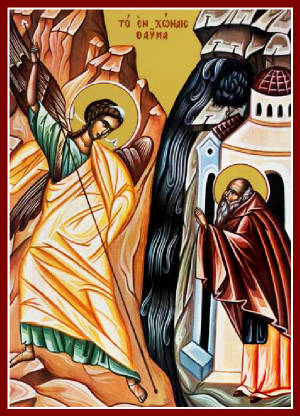
and Kufos Rivers and directed its combined flow against the church. Saint Archippus prayed fervently to the Chief Commander
Michael to ward off the danger. Through his prayer the Archangel Michael appeared at the temple, and with a blow of his staff,
opened a wide fissure in a rock and commanded the rushing torrents of water to flow into it. The temple remained unharmed.
Seeing such an awesome miracle, the pagans fled in terror. Archippus and the Christians gathered in church glorified God and
gave thanks to the holy Archangel Michael for the help. The place where the rivers plunged into the fissure received the name
“Chonae”, which means “plunging.”
The Chudov (“of the Miracle”) monastery in Moscow is named for this Feast.